The Southern Hang Gliding Club was formed in 1974, and much of what happened in those first years was lived and written down by the people who flew them. What follows are three first-person accounts of the early days of hang gliding and the founding of the Southern Club. They are reproduced here faithfully, in the words of their authors.
The Early Years, by Johnny Carr
The Southern Hang gliding Club was formed in 1974 as a result of a lot of bad press. The fear was, that if hang gliding didn’t have a strong voice in the area, and have a body that was responsible in the eyes of the powers that be, that we could lose the goodwill of farmers who were letting us use their sites. Worse, that hang gliding as a sport could be banned completely. A committee was formed, and our club has survived all sorts of pressures put on it over the years.
The sites that were most used by our club in those days were Steyning Bowl, Mill Hill and Truleigh Hill.
I had been flying several months before I launched from Devil’s Dyke. Our club used to have a special PR exercise at the Dyke, every Christmas we would have a pilot dressed up as Father Christmas. He would take off at the Dyke (weather permitting) and fly to the bottom where there was a sack full of presents for the kids of Poynings village. If the weather were unfavourable we would just rig the glider at the bottom, prior to the kids coming over. This always went down well with the locals.
Early hang gliders started much the same as the early Paragliders; you could take off and land but you couldn’t go anywhere with them. Our club grew from strength to strength with the development of new hang gliders bringing better performance. Every 6 months or so there would be a major step forward in performance, and the top pilots would always be upgrading to whatever the best hang glider was at the time. At the same time we were expanding our knowledge of thermals and these new gliders were able to use thermals to good effect.
When I started hang gliding, if we glided out from the hill and found that the glider went up bit we called it magic lift. A 360-degree turn was an artistic manoeuvre. I distinctly remember learning this scary manoeuvre. One day at Bo peep I took off on an experimental glider called a Gulp; I flew out from the hill, and proceeded to do a series of 360-degree turns. To my surprise, the ground just disappeared below me, and I found myself at about 4000’. The hill was so far below me, what with no parachute on an experimental glider, I was quite scared, but elated at the same time. When I landed, pilots on the hill said I went out of sight for a while.
I first saw this happen with Mike Robertson (Golly) as we used to call him. Bo Peep Hill (known a Firle by the pilots in those days) had a reputation for these phenomena. Of course we all know now these were thermals. These thermals combined with our 360 turns were causing us to go up. Pilots that had gliding knowledge confirmed this. The interesting part of this story is how hang gliders stepped over from being able to do no more than take off from a hill, and at best, have an extended flight to the bottom, followed by being able to stay up in a band of ridge lift, to a glider that could climb to thousands of feet, using the 360 degree method we all use today called thermalling.
Mark Woodhams writes about the early days of Hang Gliding
The beginning
It is amazing how many of the early pilots into hang gliding in the UK were involved with model aircraft. Certainly I was no different. In 1970 I had borrowed a book on aeromodelling from Brighton Library and had been fascinated by a photograph of a flexible wing aircraft called a Rogallo — named after its inventor Francis Rogallo.
I liked its absolute simplicity; just four poles and a bit of slack material slung between three of them. I took up the basic principle of the Rogallo and made many model variants which were to have led to a radio controlled craft which could happily fly hands off and be virtually indestructible. Problem was, I had very little experience of radio control, and proportional gear was very expensive.
Later on I bought the April 1973 issue of ‘Pilot’ and read the article that was to change my life. There were the Rogallo wings I had been experimenting with, but instead of being radio controlled, they had people hanging off them and controlling them by moving their weight around. As I read on I could feel the hairs on the back of my neck stand up — of course, I would build my own personal aeroplane and I would be the pilot! All around Britain that day there must have been hundreds of like-minded people all setting off on a journey that would lead some to their ultimate dream of personal flight.
I contacted Geoff McBroom who was featured in the article flying an early version of his ‘Arion’ at Westbury White Horse. I bought plans and flying instructions from him and I also got hold of plans of Dave Kilbourne’s ‘Kilbokite’, which was the first Rogallo to soar for over an hour, at Mission Ridge, San Jose.
However, things were developing faster than my ability to drill holes and put aluminium tube together. Paul Maurice, a friend from College had actually seen people hang gliding at the Long Man of Wilmington in Sussex and reported that one type of glider called a Wasp flew better than the others. We both dashed out to Wilmington, saw Robin and Terry Haynes of Wasp and promptly placed an order for a 229B3 which would be delivered to us two weeks later at a site called Anchor Valley at the back of Brighton. It cost us £175, and split two ways this was a lot cheaper than radio gear.
Mark Woodhams flies Mill Hill in 1974 on a Wasp 229B3
A group of about ten proto hang glider pilots arrived at Anchor Valley on a windswept and wet afternoon and were directed to a pile of what looked like rolled-up brightly coloured tents. These had been unceremoniously dumped onto the hillside from the back of a low loader lorry. We handed over the cash and took the brightest bundle we could find.
Terry Haynes of Wasp asked me if I knew how to fly a hang glider and I foolishly said yes. I had read Geoff McBroom’s flying instructions from cover to cover and they seemed very clear, and I was so excited that I didn’t want any technicality to get in the way of me strapping myself into the machine and gliding off into the wide blue yonder.
It was very windy at the time so Terry advised us to go down the hill where the wind was less strong. Up to this point I had experienced no fear. My expectation was that as I raised the nose and started to run gently into the wind, the hill would fall away and I would fly to a perfect landing at the bottom. The reality was that I raised the nose, but then shot vertically up thirty or so feet into the air. I pulled the bar in out of sheer panic and shot back down to the ground, landing by a complete chance on my feet. Terry and the others thought that this was very impressive for a first flight, but that we should move to a more appropriate site, because the wind was too strong and off the slope.
We arrived at Mill Hill, but I was already learning fast. I let the others go first. A wise choice as it turned out. Both the person who flew before me and after me, had crashes which damaged both pilot and ‘A’ frame. My flight, when it came, was good but I still don’t really know what I did right. At any rate I landed safely at the bottom having flown over the tops of several trees, and I remember a shouted ‘Geronimo’ before folding it all up and racing back to the top of the hill to do it all again.
Feelings like this must be common to all who fly for the first time. I had without knowing become a member of the most exclusive club in the world — free flyers.
Formation of the SHGC and the British Hang Gliding Association
The only gliding organisations relevant to us at this time were the NHGA (National Hang Gliding Association) and the BKSA (British Kite Soaring Association). These two groups were set up supposedly to represent hang gliding at a national level. But what we were beginning to need was a Club that operated at a local level. People were joining the sport at an alarming rate. New pilots would descend on the Downs area with no idea how to behave in the countryside. Gates were left open, crops trampled, permission to fly was not requested. Very soon sites began to be lost and the accident rate began to give us an unsavoury reputation.
A group of us got together and hurriedly put the Southern Hang Gliding Club (SHGC) together. We started talking to the farmers, the landowners, the local authorities and the Press. Flying Clubs were being started up all over the country and we were all having the same sorts of problem, but there was no effective central body to correlate our efforts.
The NHGA and the BKSA were unable to provide the sort of help that was really needed. The allegiances that were formed at that time were more concerned with the type of hang glider you flew. This factionalism bedevilled the early days of hang gliding. John Malin who operated out of Steyning Bowl was agent for Birdman so those flyers joined the BKSA, but five miles away in Brighton pilots all joined the NHGA because they mainly flew Wasp and a few flew the emerging Hiway. Yet we were all members of the SHGC. Quite a few of us joined both organisations because we were so hungry for any information related to hang gliding.
Other areas of the country tended to be influenced by whatever make of hang glider was prevalent in their locality. Len Gabriels in the north with Skyhook, Gerry Breen in the west with CustomKites, and a liberal scattering of Seagull 3 flyers on gliders imported from the States by Critchley Hughes. The two national organisations vied for supremacy and of course the public were utterly confused.
This was the period where sponsored ‘meets’ would be arranged at major sites up and down the country. The NHGA promoted the ‘Stella Artois Open’ at Steyning Bowl.
There was the invitational at Rhossili in Wales at which every pilot it seemed in the country attended. The flying fraternity were able to discuss their problems and it became clear that the two organisations were far too involved in commercialism to be viable independent national organising bodies, capable of representing us.
It was evident that the NHGA leaned heavily towards Wasp, indeed John James the charismatic leader of the NHGA turned out to be a close relative of the Haynes family who owned Wasp. I remember being scandalised by this revelation. Ken Messenger of Birdman was more open about his BKSA connection, but the links between the BKSA and Birdman Promotions, who sold the Albatross and Hawk gliders were commercially too close for comfort.
Coinciding with this struggle, the national press started a hate campaign against hang gliding. The Daily Mirror led with its ‘Poison Butterfly’ story, and indeed there was a rash of fatal accidents and very little formal response from the hang gliding fraternity to put the record straight or at least put our case.
We needed a national organisation, independent from any manufacturer, promoting good flying practice, disseminating accurate information to the media about hang gliding, agreeing manufacturing standards of excellence and representing all hang glider pilots interests to the various authorities. And we needed it yesterday.
By common consent the NHGA and the BKSA were to be dissolved and a totally new single organisation was to take its place. A mass meeting for all flyers was set up in Coventry on the 8th December 1974 to decide how this should happen. The following are quotations from Newsletter No.1: ‘Under the Chairmanship of Ann Welch, a total of 164 members of the BKSA and the NHGA voted a Provisional Executive of 6 members to run the new society, known as the British Hang Gliding Association. The two original societies are now wound up and membership is automatically transferred to the new association’, and ‘The new magazine is called Wings! and will incorporate the best of its predecessors. Flypaper and Sailwing.’
The provisional Executive voted in at that momentous meeting were Martin Hunt (Chairman), Chris Corston (Secretary), Mick Hayes (Treasurer), Miles Handley (Technical safety officer), Jeremy Fack (Flying training officer) and Nick Regan (Editor). In fact Dave Tait acted as co-editor with Nick. The area representatives on this first Executive were Jim Haig (Scotland), David Weeks (North), David Miller (Midlands and Pennines), Chris Maidment (Southwest including Hants and Berks), Bob Mackay (Wales including Monmouth and Hereford), John Amor (South Midlands and East Anglia) and Mark Woodhams (London and the Southeast). It is interesting to note that at a subsequent meeting the Scots broke away from the BHGA because they thought they could obtain favourable grants from the Scottish Sports Council. However they returned at a later date I am pleased to say.
In one memorable day the Flying Clubs themselves effectively wrested power from the manufacturers and established the way forward for a truly open and democratic organisation. The first ever meeting of the new Executive was held at the White Horse services on the M4, which was thought to be the most central venue for Clubs. Wings! magazine started to bring all flyers together and gradually we all came to accept the BHGA as the rightful and proper national governing body. The press started to leave us alone, and we became accepted as just another sporting group. Air worthiness standards and Schools registration began to work and the accident statistics eased. We all learnt a lot very quickly.
First records
A Wasp 229 B3 was a Standard Rogallo, had a best glide or around 4.5:1 and the sink rate of a grand piano in free fall. To stay up reliably we needed about 18 mph of wind coming straight up a steep ridge. There was no local club at that time, but the really good thing was that whenever and wherever the wind was on, all your flying mates could be relied on to be there as well. Weekdays as well as weekends. And soaring flight was the drug that drew us there. In those days success was measured by how long you could stay up for. Since most flights ended up at the bottom of the hill, you were considered an expert if you could ridge soar for any length of time.
The first duration record was established in 1972 by Geoff McBroom, flying an Arion for seven and a half minutes. By July 1973 the hour had been broken by Gerry Breen on a Quicksilver rigid hang glider, to be followed in December by Ken Messenger on a Birdman Standard Rogallo flying for 1 hour 18 minutes. In May 1974 Gerry Breen, Rob Haynes and Tony Beresford all logged flights of over 2 hours on the NE face of Hay Bluff with Tony taking the record to 2 hrs 20 mins on a Wasp 229 B3. The amazing Brian Wood of the SHGC then flew for 3 hrs 38 mins at Beachy Head in September — only to take it to an unbelievable 8 hrs 26 mins at Rhossili Down on the Gower peninsula the very next month, again flying a Wasp 229. The world record was set in September off the cliffs at Waimanolo, in Hawaii by American Harvey Melcher at 10 hrs 47 mins. By August 1976 Kev Jordan established the UK duration record at 12 hrs 15 mins on a Hiway Cloudbase. The world record went to over 15 hours, but by that time it was recognised that duration flying only proved that in some parts of the globe strong wind blows reliably up cliffs for long periods of time. Duration flying had become pole squatting. There were other flying challenges that were much more interesting and were greater tests of flying skills. Height was the new goal.
Thermals and height gain
A number of hang glider pilots and BHGA personnel had already had some experience in conventional gliding. Ann Welch was a founder member of the London Gliding Club at Dunstable and had received many honours for her contribution to that sport. Indeed it was precisely because of her gliding experience that she was approached to lend real clout to the new British Hang Gliding Association. Not only did she bring a calming influence to the excitable free-flying Council members but she wrote inspirational articles in Wings. Gerry Breen, recently out of the RAF was already an accomplished glider pilot, so he brought a wealth of relevant experience into his flying and hang glider manufacturing business. He also wrote articles about flying techniques.
But there were plenty of new pilots who had no previous experience of gliding flight and to who height gain and mastering thermal lift was a totally new experience. In July 1975 Wings ‘Soaring those thermals’ by Graham Hobson, he said … “we were soaring a small 150 ft local ridge in a 22 mph wind with clouds forming on the other side of the valley 3 miles away. which when they arrived often hefted us up to about 1000 ft … I sometimes feel a bit imprisoned by the fact that I must stay in a relatively narrow air space (when ridge soaring) in order to maintain lift … I must admit I’ve been looking for a free-er form of flying — and now perhaps I’ve found it! … I have felt that more freedom can be experienced by gaining height in a thermal and then flying cross-country”. Graham was describing how he and Bob Calvert of the Pennine Hang Gliding Club developed their thermalling skills by their direct flying experience. And remember this was being done on very primitive flying machines. It was totally new and the conventional descriptions of thermals as doughnut rings around which you effortlessly circled was a far cry from the fairly chaotic air found in a thermal forming close to the ground on a windy day. Sailplanes entered thermals at greater height where the thermals have had a chance to organise themselves into more discrete areas of lift. This sort of flying had never been experienced before.
At this time in the Southeast we often had what were known as ‘big ups’ which were exactly what Graham was describing. When these odd height gains came through it freed us to ‘360’ the height back down to ridge level. In our Standard Rogallos we were hardly ever able to do 360s in ridge lift alone for fear of hitting the hill. A 360 on a Standard Rogallo covered quite a lot of ground and lost a lot of height. You had to be in exceptional lift to be carried upwards through a complete circle and the idea of connecting with a second thermal downwind was not a practical proposition.
I first met Johnny Carr at Steyning Bowl in Sussex when I was learning to fly my Wasp 229B3. He hadn’t started flying yet, but had got the bug already to the extent that wherever it was flyable, a yellow E-type Jag announced his presence as spectator whilst waiting for delivery of his first glider. In typical Johnny fashion he bypassed the need to start on a Standard Rogallo and went straight on to one of Wasp’s CB240 more advanced offerings. In a matter of days he taught himself to fly, to soar and to stay top of the stack. From that day on John was on a mission to fly the best glider he could get his hands on. He cut his competition teeth by placing first in the Advanced Rogallo Class at the International competition at Cam Long Down in August 1974. By May 1976 he and Graham Slater were instructing at the Southern School of Hang Gliding and at the Embassy Nationals at the Hole of Horcum he again placed first in the Advanced Class, this time on a Miles Wing Gulp. At the Kossen International in September 1976 John placed a creditable tenth flying against the best in the world, this time on a Gryphon 1. In 1977 Miles Wings launched the Gryphon 2 and Johnny started his cross-country flying for real. In the first two flights out of testing the prototype at Steyning Bowl John notched up over 20 miles.
The 1977 League pioneers (SHGC members in bold): (left to right, back row) Peter Day, Chris Coleman, Graham Slater (hidden), John Hudson, John Fack, Micky Maher, Julian Thomas, Lester Cruse, Ashley Doubtfire, Mick Evan, Norman Milhouse, Mike Atkinson, Roger Black, Paul Baker, Dave Lyne, Dale Clother, Frank Taryjanyi, Roger Middleton, Chris Johnson, Roger Wates, Ken Messenger, Dave Weedon, Graham Leason, Mark Southall, Dave Worth, Miles Handley and Jeremy Fack. (front row) Tony Fuell, Tony Beresford, Bob England, Johnny Carr, Brian Wood, Bob Calvert, Bob Bailey, Graham Hobson and Brian Milton.
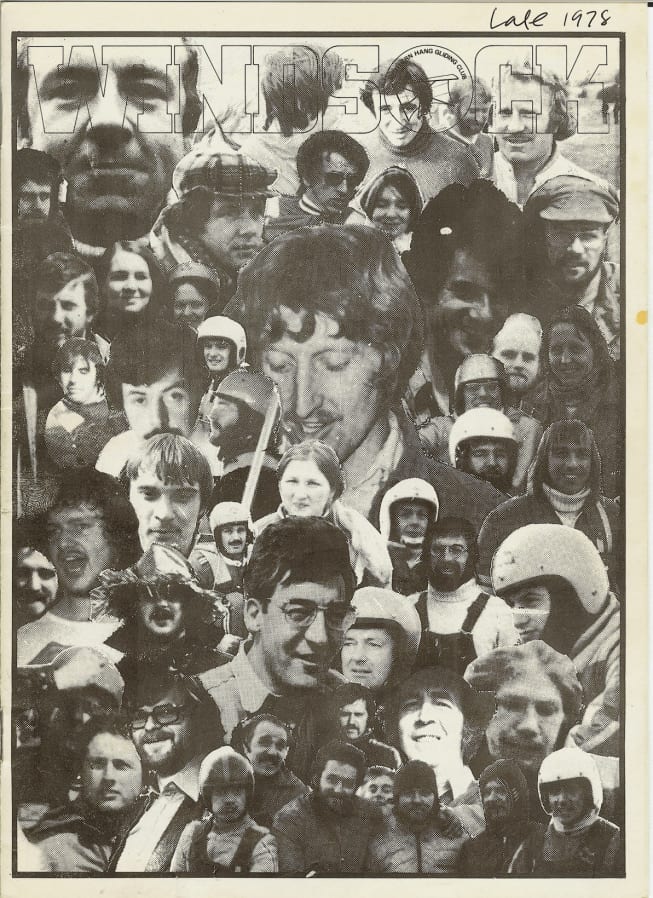
The basic complexion of hang gliding changed for ever in just a couple of months in the spring of 1977. Distance became the new goal in Club flying. I was fortunate enough to be the Editor of the SHGC’s Windsock throughout this period. The March issue covered Miles Handley’s Ditchling to Offham out and return on his new Gryphon 2. By the May issue Mike (the Golly) Robertson had followed a cloud street out from the Dyke on a Hiway Scorpion up to 2000 ft and along to Ditchling. Only 4.5 miles but no one had left the Dyke by the front door before. On Easter Monday Roger Sylvester climbed to 4000 ft above the Dyke to 360 forty consecutive times back to earth on his Wasp Falcon 4. It was reported that Mark Southall had flown 12 miles to Abergavenny and Gerry Breen’s Tredegar record breaking flight was reported as 20 miles. Bob Wisely flew from Beachy Head to Cuckmere Haven trying to repeat the out and return flight recently completed there by Johnny Carr, Miles Handley, Paddy Monroe and Steve Goad. Then to cap it all, Ray Sigrist and Graham Slater completed the Newhaven to Brighton cliffs out and return for the first time. On 1 June Johnny Carr on Gryphon 2, Geoff Lowery on SST and Paddy Monroe on Scorpion flew from Ditchling Beacon to Shoreham Airport, Worthing and Steyning respectively, overflying the Dyke en route. On 26 June Dave Roberts flew the 11.5 miles from the Dyke to Peacehaven topping out at 4650 ft. It was the most exciting time in free-flying that I can ever remember. And it was happening all over the country at the same time in most of the other Clubs. Flying would never be the same again.
© 1996–2007 Mark Woodhams
Ian Grayland writes about the Early Days of the SHGC
The Idea
Back in the early 70’s I saw a short news item on TV showing a bunch of guys flying some very basic hang gliders off a hill in California. They seemed to be having a great time, but were arriving at the bottom very shortly after take-off, so for my purposes at the time, there seemed little point to the activity and I very soon forgot all about hang gliders. I had been for some time working on a jump-start gyroplane design, having realised that the only way I could afford to fly would be to build my own aircraft. Design work was progressing nicely, when I came across a photo of a primitive hang glider in a newspaper. Again, I thought little more about it until later that evening when I suddenly realised that if you flew the thing off a steep enough hill in a wind of 20 mph or so, you would actually be able to stay up! What’s more, I already had all the equipment and machinery required for the job; a hacksaw, a pistol drill with a couple of drill bits, a small Victorian sewing machine, a pencil and a slide rule. I immediately set about designing and building a hang glider. What could possibly go wrong?
Aeronautical Engineering
Unfortunately I had failed to keep the photo, so I had very little to go on, thus my first attempt was a glider with 21ft leading edge tubes and 18ft keel. The nose angle was around 105 degrees and the resulting wing area about 340 sq ft - pretty big, but I had only reckoned to get a maximum lift coefficient of about one. After a lot of phone calls and driving around to get materials (“You’re going to built a what??! - You must be crazy!”), I was finally ready to start construction. I made the sail first, laying it out roughly on the lawn and sewing it on the kitchen table. I drilled the main spars in my back yard with a pistol drill, marking around the circumference with bits of paper for the pilot holes, then using masonry bits for the through holes (to save blunting the drills on the concrete). Reinforcing inserts had to be ‘machined’ down with a file to fit inside the 16 gauge tubes. For the A-frame tubes I soaped the ends and heat-treated them on the gas cooker before shrinking inserts into place in the kitchen sink. Probably the hardest bit was drilling the Woolworth’s hardware dept bolts to take key-rings to secure the wing nuts. After load testing the frame by balancing one end of the cross tube on the garden fence and the other on the shed roof, then jumping up and down in the A-frame, I was ready to go flying.
Flight Testing
The maximum lift coefficient turned out to be rather better than I had estimated - no question of needing to run for a landing; a lazy walking pace was plenty - the wing was way too big. This was not the only problem either, as I found out on my first flight. I had located the hang point by assigning a first guesstimate and then accurately calculating the difference to where it should be. Five inches. I carefully built the wing with the hang point five inches further aft. Disaster! It should have been five inches further forward! This made my first flight a little tricky with the hang point some ten inches too far aft - bear in mind, I had to teach myself how to fly at the same time as figuring out the shortcomings of my design. Even so, I did manage to top land on that first flight at Anchor Valley in a stiff Westerly breeze - by virtue of being unable to get to the bottom! I rounded the flight off in style with my first ground-loop. Thus ended many years of confidence in my own mental arithmetic and began the first of many years of flight-testing, bending, bodging and re-testing countless experimental aircraft. Some might call this a career. It certainly involved a lot of careering around the sky!
Flying, Flying, Flying
Following the first few flights, I re-designed the wing, mostly with a hacksaw. I cut the leading edges down to the same length as the keel. That way it folded neater. I reduced the nose angle to around 90 degrees, which cut the wing area to about 220 sq ft and went off to learn how to fly it. Things were much better now. Although the glide angle wasn’t so good, I could take off and land reliably and, better yet, I could actually steer the thing in flight! Then in the Spring of 1974 a new development emerged. Other people! There were other people out there on the South Downs attempting to commit aviation just like me!
Apart from the obvious social benefits, flying with a group like this produced a real boost in my learning speed, since I could learn from the mistakes of others as well as my own. I soon discovered that I could get higher and stay up longer than most by virtue of my superior sink rate. Conversely, my glide angle was so bad that often I couldn’t make it over the fence into the landing field with everybody else. Eyeballing my fellow aviator’s mostly cobbled-up, home-made or kit-built machines revealed that the ones that glided best had, amongst numerous other differences, one key element; non-porous sails. By now thoroughly hooked on flying, as opposed to sewing, I rushed out and purchased a ready made rip-stop nylon sail and after ten minutes with the trusty hacksaw fitted it to my airframe. Success! It flew a treat! I had an even better sink rate and could now actually out-glide most of the others as well. The glider looked a real beauty too in its two-tone blue. A man could be proud of a machine like that. Well, until he realised that he could make a much better one…
Competition Success
It was on this same glider that I entered the first British Championships held at Steyning Bowl that Summer (1974). There was no entry fee and, better yet, when you signed-in as a competitor they gave you six bottles of Stella lager, so it was well worth entering. Unfortunately the wind was a brisk SW and, even after a couple of breakfast beers, the idea of flying through appalling turbulence to the bottom of the bowl for a pointless spot-landing task didn’t appeal. I went to the sponsor’s tent, cadged another six bottles of beer and went off to Mill Hill to go flying.
This turned out a brilliant day for me. I got in several hours of soaring, my bottles of beer jammed inside my denim jacket. I opened them in flight on the A-frame corner brackets and came in for a succession of top-landings to dispose of the empties. Best of all, I finally worked out how to top-land (this was quite a new thing at the time). On my first attempt I got it all wrong and knocked one of the spectators out of his wheel-chair. Luckily I was undamaged and he apologised profusely for getting in the way! Anyway, I got more free beer and more flying that day than anyone else entered in the competition, so I reckon I won.
Theory Into Practice
I had written an article for the national association magazine on the theoretical possibilities of gaining extra height in ridge-lift using thermals. The first time this happened in reality was such a surprise to my fellow fliers that they stopped flying and abandoned their gliders at Anchor Valley, having seen me flying from there at Mill Hill. The whole bunch piled into their cars and rushed down the road to Mill Hill to regail me with questions to which I had very few answers. I wasn’t sure at the time if it had been thermal or wave. These days of course any one of us would immediately recognise thermal lift and the onset of sea-breeze convergence.
On another afternoon we were soaring at Mill Hill when the sea breeze became a true Southerly. The turbulence was fairly severe and the only real lift was way out over the bushes at the North end. So someone said “How about Newhaven? That faces South…” A bunch of us jumped in a couple of cars taking my glider and a Hiway Standard with us and shot off to the cliffs. Now at this time we knew it was theoretically possible to fly a cliff and had read of some guys in California flying a coastal cliff by launching from a big hill behind it and landing on the beach. But actually launching from a cliff?? After walking back and forth along the top of Newhaven cliffs for half an hour or so scoping out the severe rotor (it was blowing over 25mph), I chose a rounded bit of cliff edge with clean airflow and enough space for someone on the nose wires and off I went. After a short flight in smooth, strong lift I made an easy top landing in a rotor free zone and had a second flight, quickly followed by Martin Farnham, the component maker at Brighton HG manufacturer Hiway - now ‘fully recovered’ from ‘the towing incident’, who flew my wing rather than go and fetch the other one.
Southern Hang Gliding Club
One of the keenest local fliers, graphic designer Mark Woodhams, approached me one afternoon at Mill Hill with John Malin, the Steyning Bowl HG school proprietor, in tow. “We’re thinking of forming a club to protect our flying sites and generally look after local fliers interests. It’ll cost money. We reckon twenty five quid each will do to get things started. Some of the others have already agreed, can we count you in?” “OK. As long as he doesn’t get to handle any of the money…” The SHGC was founded later that Summer, the result mostly of Mark’s hard work and the boundless enthusiasm of guys like Johnny Carr, who was the first to actually hand over a cheque. Everyone joined - I mean everyone. Incidentally, twenty five pounds back then was a lot of cash, like maybe 200 or more now. National Hang Gliding Association annual membership including third party insurance and the Illustrated Monthly Fly Paper was only three quid. I can still remember reading the first Exchange and Mart ads for the NHGA and being reluctant to join thinking it looked a bit of a con…
British Hang Gliding Association
Turned out it wasn’t actually a con at all, though there was a bit of deception involved. The NHGA was run by enthusiastic flier John James. It was expanding fast and had organised appropriate publicity and suitable third party insurance for flying members on a shoestring. In fact all was running quite well, despite the best intentions of rival organisation, the British Kite Soaring Association. Unfortunately, it then came out that ‘John James’ was acually Peter Haynes, the oldest of the Haynes brothers, the younger two of whom ran local HG manufacturer Wasp! Oops! After a lot of name calling and a hell of a political bun fight the BKSA and NHGA were merged to form the BHGA. Apart from the increased number of members and an improved magazine, ‘Wings’, all this argy bargy had lead to a properly constituted National Association, providing a sound legal basis for the foundation of ‘Member Clubs’ like SHGC.
My First Flying Trip Abroad
I used to go to the Isle of Man for the Manx GP in early September most years with a group of friends. We’d take our bikes (typically not UK street legal) up to Liverpool in a van, then ditch the van in Liverpool and get on the ferry with our bikes. This year was different; I took my glider on the roof of my TR4a. There was a Hang Gliding Club on the island (with three members and one, currently broken, glider). Though very friendly, they didn’t seem to know very much about the Met or the best local flying sites and were obviously in the very early stages of learning. However, there appeared to be no potential problem with flying more or less anywhere on the island. Despite this being a bit of an alien concept after the attitude in Sussex, I set out with my OS map to try a few sites. Anyway, I had a couple of flights, but the best was from Snaefell, the biggest peak on the island.
I took off from a shoulder of the mountain alongside the road in a stiffish SW wind. Up I went. And back a bit. And up some more. As I passed the mountain railway on the way up the driver stopped the train and he and all the passengers got out to watch! They were waving and photographing like mad. I wrapped one arm hard round the control bar to keep penetrating while I waved back. After a short, but enjoyable flight in ever increasing wind, I landed on the top of Snaefell. Early the next morning I was rather ominously awakened by a phone call at my B&B. Expecting it to be the plod, or some irate land owner, I battled my way to the phone very carefully past the biggest Manx cat you’ve ever seen (“Well, that’s sort of ‘his’ room. He’s absolutely fine as long as he likes you…”). It was Manx Radio wanting to know where and when I’d be flying today so they could tell people where to go and watch! Oh, and could they be of any help with weather forecasts or anything like that? A stark contrast with the attitude to fliers still prevalent in Sussex today.
Building A Better Glider
My airframe still had the original un-anodised extruded alloy tubes, much bent, re-straightened and cut about by now, together with rusty Woolworth’s bolts and bare galvanised steel rigging wires clamped with those horrid little U-bolt cable clamps. I had done a fair amount of development work and added some extras. I had one of the first king-posts, though mine was only fifteen inches tall and had just a single fore and aft cable to hold the reflex in the keel. The tendency of the cross tube to get bent when parked nose down in a wind, requiring it to be constantly un-bolted and inverted (no kidding, this was common practice!), had been more or less eliminated by the addition of a shackle on the nose wires to allow the wing to park flat on the ground. The control bar had always had a ‘belly-bulge’ in it (‘speed bar’ it’s called these days) and was removable using wing nuts and safety rings, though I rarely bothered to fold the A-frame, preferring to keep it rigged as I had no bag to keep the glider in anyway and it kept the wires from flapping about while the glider was stored on the roof of my car. My variable geometry crosstube ends had also been very useful for fine tuning the billow and I had now reached the practical limit of performance from the rip-stop nylon sail.
Realising that there was a big boost in performance to be had, I was mad keen to get a new sail made in some decent heavier polyester sailcloth and, at the same time, tidy the rest up a bit. After ordering the new sail for me, the guys at Hiway let me build the fiddly bits of my new frame in their factory in Bernard Road, Brighton. This time I used anodised tubes all round - no more black marks on the sail and black hands after flying - and, after tweaking and tuning the wing, I added a complete new set of properly swaged plastic coated rigging. The finished glider looked superb with its pristine all white sail. It flew really well too, fully justifying my extra expense and effort. Glide and especially penetration performance were much enhanced. A man could be proud of a machine like that. Well, until he realised that he could make a much better one…