Live wind — Newhaven Breakwater
Live measured wind at Newhaven Breakwater · by WeatherFile. Reading it against the forecast tells you if the sea breeze is in. Shown in km/h — change it in your account.
Quick facts
- Wind direction
- SSE – SSW
- Take-off height
- 180 ft amsl (55 m)
- Height top-to-bottom
- 160 ft (48 m)
- Pilot rating
- Pilot (HG) / CP+ (PG)
- Unsupervised
- HG: Pilot. PG: CP for unsupervised flying east of 'the point'; Pilot, or CP + 10 hours in the last 12 months, beyond 'the point'.
- Airspace
- 5,500 ft QNE
- OS grid ref
- TQ 446 000
- Nearest town
- Newhaven
- Car park postcode
- BN9 9DK
- Nearest A&E
- Brighton
About this site
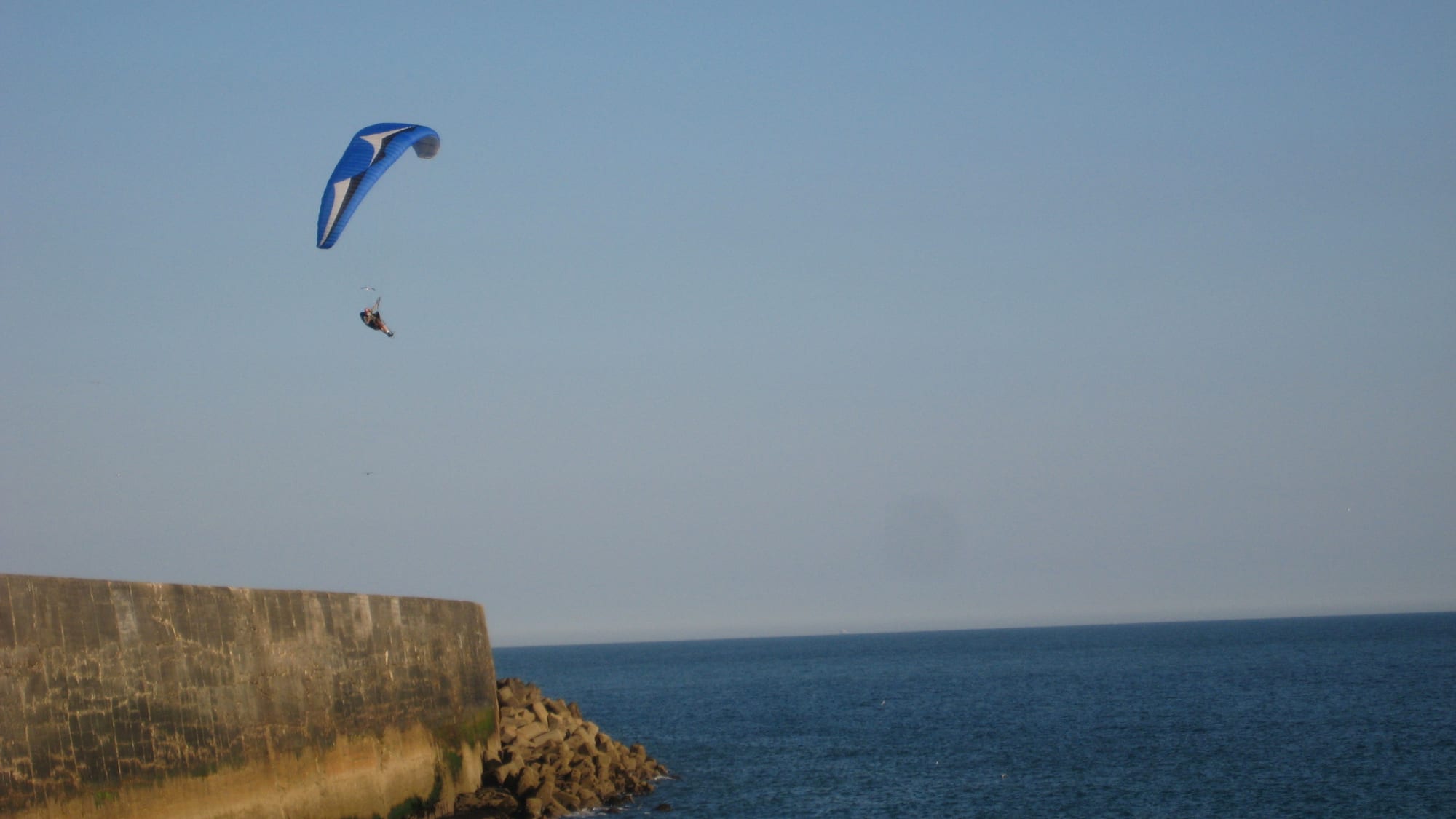
Newhaven is a cliff site offering excellent coastal soaring. Because it is relatively low, it can be flyable when Beachy Head isn't working or when Caburn is blown out, and in the right conditions a 6.5-mile cliff run to Brighton Marina is possible. There is a short south-easterly section east of the coastguard tower (to the fort and back); to the west of the tower there is half a mile of south-facing cliff leading to the mainly south-south-west run to Brighton. Newhaven Cliffs is Castle Hill Nature Reserve — a managed site closely monitored by Lewes District Council, and we have a good relationship with the Coastwatch coastguard team.
Site rules
Newhaven Cliffs is known as Castle Hill Nature Reserve — a 'managed' site, closely monitored by Lewes District Council. Local by-laws make it a legal requirement to be a current member of SHGC before flying this site. Because the site is shown on Paragliding Earth and similar websites, there is a risk of foreign pilots and non-Members attempting to fly here with inadequate knowledge of the dangers, restrictions and procedures. While this applies to other sites, it is particularly important at Newhaven Cliffs, where our existing historical informal arrangement could be lost through one further 'unfortunate' incident. When flying at Newhaven, Members should recognise that we all have a collective responsibility for site conduct and safety and be prepared to challenge any pilot whom they do not recognise as a member, and ensure that they are aware of the Membership requirements and the local restrictions and procedures for the site without which they should not be allowed to continue to fly. It is strongly recommended that a life jacket is worn when flying this site. Tides — do not fly west of 'the point' (the south-facing cliff and the run towards Brighton) within 3 hours before and 2 hours after high water. At high water there is no beach to land on along this stretch and a water landing is usually fatal; check the tide tables (tidetimes.org.uk/newhaven-tide-times) before committing to fly west. Do not overfly the Park Homes site to the west of take-off. Do not fly north of the cliff near the bungalows and endeavour to stay as far south as the lift allows. Transit through the area next to the retirement park as directly and quickly as possible. Show consideration for the residents of this site by avoiding excessive noise when flying in the vicinity of the bungalows. Keep voices and radios silent in that area. Hang gliders are no longer permitted to gain access through Park Homes Estate. Soaring the harbour arm is extremely dangerous and has resulted in a number of near drownings. The SHGC strongly recommend you do not attempt to do so. Emergency Landing Signal — if there is an incident, accident or exercise requiring a rescue helicopter to attend, the Newhaven Coastwatch volunteer coastguards will alert pilots by sounding an air horn with 4 short blasts (Morse code H). LAND AT ONCE. Mobile phone signal is limited to non-existent on the beach to the west of take-off — do not rely on a phone to summon help there. Carry a radio (SHGC safety frequency 143.950) and do not fly this stretch alone.
Getting there
Directions
By road, follow the one-way system around Newhaven town centre to the left, turn at the police station (South Road) and take this into Fort Road. For the Fort car park, turn right after the sports ground and go up the hill into the car park, then up the track to the take-off by the Coastguard station. For the beach car park, continue straight, then turn right once in the car park and park at the far end. By public transport, trains run regularly to Newhaven Town Station, from where it is approximately a 1.5 mile walk via the Fort Road (see above). Alternatively, The Brighton and Hove Buses Coaster service, number 12 bus runs regularly between Brighton and Eastbourne and stops throughout Newhaven town centre, approximately 0.7 miles from the Fort car park.
Parking
Normally use the Fort car park (up the hill by the Coastguard station — nearest the take-off), or alternatively use the beach car park (by the bottom landing) if that is full. Beware of thieves in these areas; it is unwise to leave valuables in your vehicle. Check the car park closing times, which are different in summer and winter. The fort car park has a height barrier which is sometimes opened during the daytime. Don't get locked in!
Conditions & airspace — Newhaven Cliffs
Live wind for this site. Guidance only — always make your own assessment on the hill.
Sea temperature — Newhaven Cliffs
Checking the sea temperature…
Air & modelled sea-surface temperature by Open-Meteo.com (CC BY 4.0) — a satellite/model estimate, not a measured reading. Cross-check the real Seaford wave buoy (nearest in-situ sensor) before relying on it. Guidance only — always judge conditions on the hill.
Tides — Newhaven Cliffs
Checking the tide…
Tidal data modelled by Open-Meteo.com (CC BY 4.0) — guidance only, not an official tide table. For navigation/safety-critical use, consult official UKHO tide tables.
Wind — Newhaven Cliffs
Consensus (mean) · daytime hours · updated hourly
Average of the main models — cuts single-model noise
Weather data by Open-Meteo.com (CC BY 4.0) · Consensus (mean). Forecasts are guidance only — wind on the hill can differ from the model. Always make your own assessment on site and fly within your and your site’s limits.
Model comparison
Loading every model…
Thermals — Newhaven Cliffs
Star rating from RASP (Stratus) — the UK soaring standard
Star rating & thermal forecast from RASP UK (Stratus); supporting figures modelled from Open-Meteo.com (CC BY 4.0). Guidance only — always make your own assessment.
Flying detail
Access & launch
Paragliders — the two most-used launches are in front of and slightly east of the coastguard tower (SE winds), and on the plateau about 200 m further west (S and SSW winds); there are many other places to launch. Hang gliders — the main take-off is a small clearing at the cliff edge 50 m west of the western PG launch (HGs can hit rotor using the PG launches, and the old launch at the western PG launch has been reprofiled by land slippage and is no longer safe for HG). If using the eastern PG launch in SSE winds, HGs should only cliff-launch — do not launch from further back or you will hit rotor. A nose-man is recommended for all launches, tethered to a suitable ground anchor. Rigging — HGs rig at the HG take-off (beware rotor causing wind to flow towards the cliff edge). PGs rig well back or to the side of the launches and mushroom rigged kit to the side, leaving enough space for top landings.
Landing
Top landing — hang gliders should not generally attempt to top-land; the area (the PG western launch) is small, the overshoot is over very rough ground, and going too far back or too low on overshoot risks serious rotor. Paragliders usually top-land at the back of the main rigging area — be careful not to misjudge the approach and end up in the deep brambles; you can land close to the cliff edge, but be very careful not to fall off or be pulled off by rotor. Bottom landing — land on the beach near the car park and well back from the sea; hang gliders in particular can float on and into the sea if the approach is too far forward. Do not land in the harbour — there is now no way out! In high summer the bottom-landing area can be too crowded with beachgoers to land safely.
Hazards & obstacles
Most of the site is a vertical cliff. The wave-cut platform ('Black Rock') is deeply eroded chalk covered in algae — near impossible to walk on safely, let alone land on; several pilots have broken limbs trying. Various objects protrude from the cliff — do not snag a wing. In light winds, remember the need to clear the cliff edge in front of take-off — you are launching over a hole in the ground behind a vertical cliff. Do not fly over areas with no bottom landing: if there is insufficient lift to soar you will have very little time to set up a bottom landing, and in marginal winds, if you are at the fort when the lift fails, you may not reach the bottom-landing area. The Brighton run — consider the state of the tide (tables at tidetimes.org.uk/newhaven-tide-times). Take it seriously: a water landing is usually fatal, landings on the black rock often break bones, and if the lift dies there is very little time to set up, with long stretches of no good landing even at low tide. Because of the high accident rate beyond the permanent beach, pilots flying there must be skilled at rapid set-up for an accurate landing and able to judge conditions — hence the recommended minimum ratings beyond the beach: PG — Pilot, or CP + 10 hours in the previous 12 months; HG — Pilot. The airflow at Brighton Marina is very turbulent — do not fly above or beyond the eastern arm. In high summer the bottom-landing area can be too crowded with beachgoers to land safely.