Flying detail
Access & launch
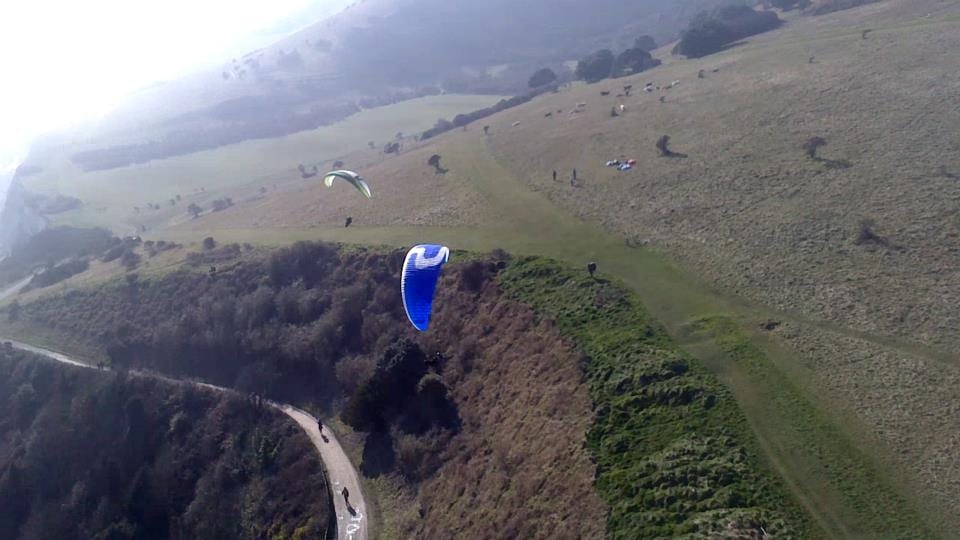
Take-off — In a SE wind (to soar the bowl), hang gliders take off from the pad, the high point at the south end of the rigging area; paragliders from the pad or the grassy slope to either side. Clear the top take-off / landing area as soon as possible. To soar the south cliffs (Pilot-rated only), PG and experienced HG launch from the Cliff Bowl just south of the SE launch — beware turbulent flow in the cliff bowl if the wind is strong or off-direction. Ensure the area in front of take-off is clear of people before launching.
Rigging — rig on top of the raised bank opposite the car park, leaving at least 10 ft clear at the front for public access.
Equipment & Site Marshal — whenever the site is flown the marker flags and site windsock must be used. They are kept in a tube marked 'SHGC Flags' on the rear wall of the coastguard station beside the car park, secured with a combination padlock; the code is [members only] — lock it back on the hasp so it doesn't get nicked. The first pilot to arrive sets out the flags and windsock and becomes Site Marshal: the yellow marker flags must always be displayed, and the Marshal must text Eastbourne Borough Council (07939 580433) to advise that flying is taking place and the approximate number of pilots (the text won't necessarily be acknowledged). If flying does not then happen, text again — failing to may cost us a flying day later in the season. If the Marshal leaves before flying ends, the duty must be passed on, and all equipment returned to the tube and locked.
Windsock — a telescopic windsock pole is kept in the equipment tube at Beachy Head. It has an associated ground spike, which can be pushed into hard ground reasonably easily. The pole in its stowed configuration has a plug at the smaller end which, when removed, allows the top sections to slide out and be twisted into friction lock with the sections below. When fully extended, the larger end cap can be unscrewed and the pole placed over the ground spike. Please keep the plug and end cap in a zipped pocket so that they can be replaced; try not to lose them. A clip is attached to the pole tip so that the windsock swivel can be easily and securely attached. After use, make sure the pole is stowed properly and the plug and end cap replaced.
Landing
Top landing — do not land on the main top landing in a southerly: rotor off the cliffs can be severe and dangerous. On approach, do not stray downwind of the path along the road, and keep enough height coming in parallel to the road; you come down quickly when you turn into wind, so risk overshooting rather than being dumped. The HG main top landing is tight and needs a precise approach — there are bigger, easier, safer top-landing fields down the road east towards Eastbourne. For HG, the field in front of the pub is for Pilots only; do not overfly the pub. CPs may top-land in the big fields down the road east, or bottom-land in the field below the main bowl. The PG top-landing area is behind take-off — do not get too far back, as the venturi can be strong; in strong winds consider bottom landing or, if high enough, land well back from the cliffs along the road towards Eastbourne. Keep an eye on the top-landing area and give polite warning of imminent top landings to people in the vicinity of the landing area.
Bottom landing — the large field at the foot of the south-east bowl is available. At low tide there is a triangular area of sandy beach at the SE point between bowl and cliffs, but be wary of approaching the lower cliffs if overshooting, in case of rotor. It is generally inadvisable to bottom-land close to the base of the cliffs.
Hazards & obstacles
There is little bottom landing below the cliffs — only a narrow strip of beach with very large, slippery rocks, exposed only at low tide.
Aeromodellers — our relationship with local modellers is friendly; in south-east winds, visiting modellers should be encouraged to use the Whitbread Hollow bowl to keep separation, and kite fliers the dedicated kite flying / buggying area on the other side of Whitbread Hollow.
Airflow
Wind off the sea is generally smooth, but when the lapse rate is poor or the unstable layer very shallow, serious turbulence can be generated — be especially vigilant in summer when air temperatures are high relative to the sea. In poor lapse-rate conditions the air can be reluctant to rise up the 500 ft south cliffs; even with a 20+ mph southerly there is sometimes insufficient lift to soar, and if the wind is east of south you may find it impossible to reach the bottom-landing field. Before taking off, check whether birds are soaring — if they are not, neither will you. Adverse temperature-gradient conditions can cause severe turbulence from velocity differences between the wind above and below a separating inversion layer, which often forms at or around take-off height; check the wind is constant in speed and direction at take-off and further down the slope. Beware rotor immediately behind the cliffs and wind gradient behind the bushes, rotor in front of the cliff face below the clifftop, and flying behind large out-croppings or spurs on the cliff face when the wind is off the cliff. Do not fly beyond gliding reach of a safe landing.
Exact launch
- Launch GPS
- 50.73994, 0.25314
- What3Words
- Car park: ///gala.builds.character
Emergency
- Emergency grid ref
- Car park: TV 590 959 (N50.741384 E0.253258)
- Emergency W3W
- Take-off: ///atom.softly.catapult -- Bowl bottom landing: ///adopt.equal.encloses
Members also see the gate / padlock code (where a site has one), the Safety Officer’s contact, and the downloadable guide (PDF). Member sign-in · Join the club