Quick facts
- Wind direction
- ENE – SE
- Take-off height
- 250 ft amsl (76 m)
- Height top-to-bottom
- 220 ft (67 m)
- Pilot rating
- CP+
- Unsupervised
- Top and slope landing tasks signed off
- Airspace
- 5,500 ft QNH
- OS grid ref
- TQ 510 011
- Nearest town
- Cuckmere valley, south of Alfriston (NE of Seaford)
- Car park postcode
- BN25 3AB
- Nearest A&E
- Eastbourne
About this site
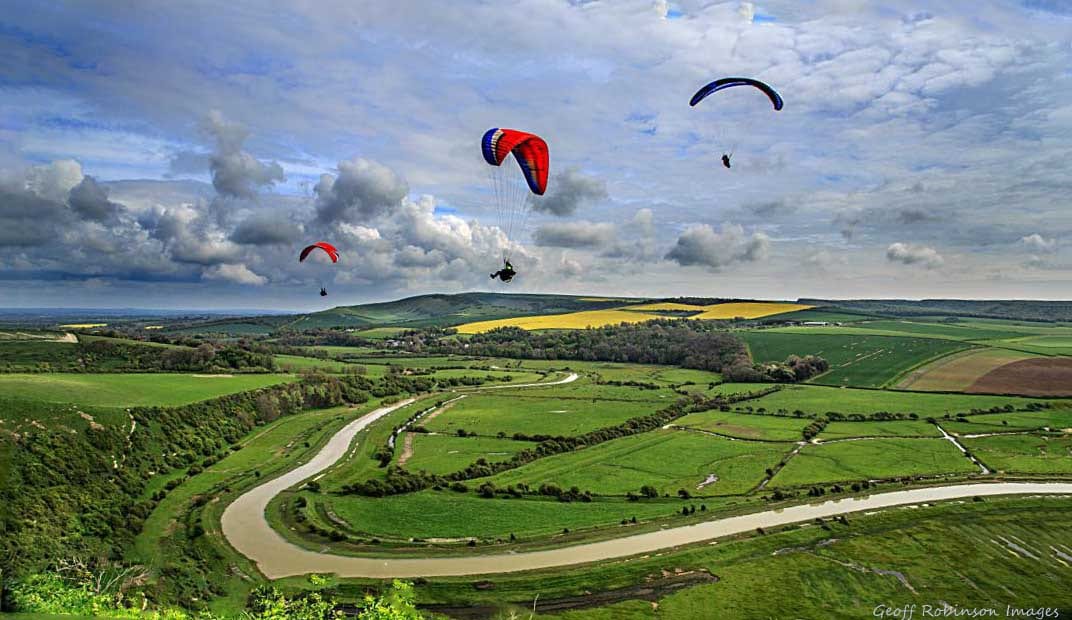
A small, steep, tree-covered bowl facing due east over the Cuckmere river valley, High and Over evokes strong emotions amongst fliers — most either love it or hate it. This is not a good site for inexperienced hang glider pilots.
Site rules
This is not a good site for inexperienced hang glider pilots — and, as with all our sites, never fly it without a full site briefing. Rig away from the take-off and top-landing areas, do not leave gliders obstructing them, and do not block the public footpaths.
Getting there
Directions
High and Over is in the Cuckmere valley south of Alfriston, between Lewes and Eastbourne and just north-east of Seaford. By road it is best from Seaford on the A259, then north on the B2108. If you drive through Alfriston village, take care — the high street is very narrow and usually full of tourists. From the car park, follow the left path for the south-east take-off, or the right path for the east take-off. By public transport, Cuckmere bus 26 runs on Sundays and bank holidays from Seaford and Eastbourne railway stations and stops immediately alongside the High and Over car park. Route 126 runs Monday to Saturdays from Seaford and Berwick railway stations and again stops immediately alongside the High and Over car park. Check bus timetables before you set off. Or you might try the Flexibus service for which rides can be booked either by phone or using the local booking app.
Parking
The public car park is two miles from Seaford and one mile south of Alfriston on the B2108. There are no daytime restrictions, but overnight parking is not permitted; there is a lay-by opposite that can also be used. It gets very busy — park considerately, and if it is very busy do not block the road (there has been police interest in the past); instead park down the road on the outskirts of Seaford and walk or hitch up the hill.
Conditions & airspace — High and Over
Live wind for this site. Guidance only — always make your own assessment on the hill.
Wind — High and Over
Consensus (mean) · daytime hours · updated hourly
Average of the main models — cuts single-model noise
Weather data by Open-Meteo.com (CC BY 4.0) · Consensus (mean). Forecasts are guidance only — wind on the hill can differ from the model. Always make your own assessment on site and fly within your and your site’s limits.
Model comparison
Loading every model…
Thermals — High and Over
Star rating from RASP (Stratus) — the UK soaring standard
Star rating & thermal forecast from RASP UK (Stratus); supporting figures modelled from Open-Meteo.com (CC BY 4.0). Guidance only — always make your own assessment.
Flying detail
Access & launch
There are two take-off areas. From the car park, follow the left path for the south-east-facing launch, or the right path for the east-facing launch. Both are smallish — the east one particularly so. Rig away from the immediate take-off areas; paraglider pilots should only approach the launch once clipped in and holding a mushroomed glider. South-east-facing launch — there is a stock fence right in front of it. The farmer and the National Trust have agreed a four-span removable opening that makes a clear launch from near the bowl side towards the northern end of the launch area. Opening the fence gap (combination [members only]) — remove the padlocks at the central removable post; the code is [members only], set against the engraved black line on the face of the lock (set the other side and it won't open). Push the button at the base of the lock to open it; hold the lever handle while removing the lock, as the fence is under tension and the arm may fly up rapidly (gloves help — the locks are often oily). Raise the lever arms to about 45° and replace the locks immediately in the holes on the arms so they aren't lost. Raise one arm fully, slip the chain link off the post hook, remove the spike at the base of the metal post from the lower retaining ring, and lay the post on the slope; repeat on the other side. Remove the central post from its socket and lay it behind the remaining span on the right. Pick up one metal post and walk in a circular arc across the slope, lifting the fence so the sawn-off post doesn't drag, and fold the mobile section back against the solid fence, retaining it with the upper wire strands. Repeat for the other side, and check no wire is sticking out that could snag a line. Closing the gap — reverse the procedure: replace the central post (lower retaining ring to the left, where the ground is lower), insert the metal-post spike into the lower retaining ring, pull the top towards the central post until the chain link slips over the hook, remove the padlock, push the lever down until the tongue goes through the slit, and reinsert the lock — making sure the code is NOT left aligned with the black line. Repeat on the other side and leave the area clear and tidy. Report any problems to the Sites Officer or a Committee member; photos and full instructions are at shgc.org.uk/highandovergate. If you dropped the fence at the start of the day it is your responsibility to close it — if you leave while gliders are still flying, hand that duty to someone else. East-facing launch — the first sloping terrace below the stile. Expect a steep wind gradient: PGs typically inflate well back and ground-handle forward to the edge, or lay out on the edge and walk down the slope; HGs should cliff-launch from the edge, or run off the point at the lower end of the terrace (HG pilots may prefer an alternative site).
Landing
Top landing (south-east launch) — the area is immediately behind take-off and needs a careful approach. Avoid over-flying the road, beware rotor or steep wind gradient behind the trees, and land between the sunken pathway and the front fence — do not land or get dragged into the sunken pathway. It is much easier to land in the gently sloping field below and to the left and walk up a few yards. Top landing (east launch) — the area immediately behind take-off; watch out for the fence, the trees, the slope, the wind gradient, rotor and spectators — a fairly challenging landing. It is very easy to land in the next terrace down to the right and walk up a few yards. Bottom landing — the field immediately below the take-off slopes; keep enough height if you need to cross the river to reach it. Do not land in the field on the opposite bank (no permission); if you unavoidably do, pack up and walk north-east up-river 500 m to a bridge. There is no vehicle access for retrieves in the bottom landing — you will have to walk back up; paths lead up to each take-off.