Quick facts
- Wind direction
- NW – NNE
- Take-off height
- 540 ft amsl (165 m)
- Height top-to-bottom
- 320 ft (100 m)
- Pilot rating
- CP+
- Unsupervised
- Top and slope landing tasks signed off
- Airspace
- 5,500 ft QNH
- OS grid ref
- TQ 468 059
- Nearest town
- Firle, off the A27 (between Lewes and Polegate)
- Car park postcode
- BN8 6NA
- Nearest A&E
- Eastbourne or Brighton
About this site
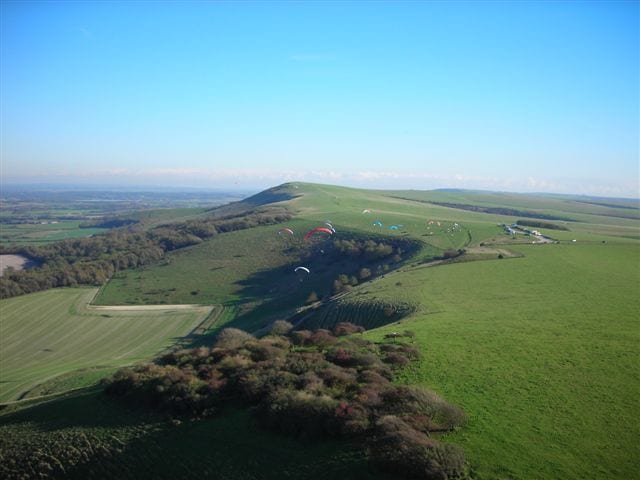
Firle is a north-facing bowl adjacent to the top car park above Firle village. It gives flying access to the northerly section of the Firle ridge and the north-westerly section of ridge beyond Beddingham, as well as the north-easterly Bo Peep ridge.
Site rules
Show consideration to all users of the South Downs Way, which runs along the southern side of the rigging / top-landing area — and close all gates.
Assume horses will be frightened by moving canopies and low-flying hang gliders; give them plenty of room (fly away from horses, not towards them).
Do NOT park in front of farm gates. Do not launch — or land and re-launch — anywhere between the Firle Plantation and the Bo Peep quarry; if you bomb out there, pack up and walk back.
Getting there
Directions
Between Lewes and Polegate on the A27, turn south at the sign-post for Firle. Continue up the hill and the bowl is on your left. At the top, the parking area is on the left — a footpath gate leads straight into the rigging field, and there is a stile over the fence opposite the entrance.
Parking
Large public car park (paid parking since 2023) — beware of thieves operating in the area, and do not block the way for large agricultural machinery.
Services
Food, drink and toilets at Middle Farm on the A27; pub and village shop in Firle village.
Conditions & airspace — Firle
Live wind for this site. Guidance only — always make your own assessment on the hill.
Wind — Firle
Consensus (mean) · daytime hours · updated hourly
Average of the main models — cuts single-model noise
Weather data by Open-Meteo.com (CC BY 4.0) · Consensus (mean). Forecasts are guidance only — wind on the hill can differ from the model. Always make your own assessment on site and fly within your and your site’s limits.
Thermals — Firle
Star rating from RASP (Stratus) — the UK soaring standard
Star rating & thermal forecast from RASP UK (Stratus); supporting figures modelled from Open-Meteo.com (CC BY 4.0). Guidance only — always make your own assessment.
Flying detail
Access & launch
Take-off — do not launch anywhere between the Firle Plantation and the Bo Peep quarry. The main take-off is the large field north of the car park, but the trees in the bowl have grown and there is now turbulent flow across the take-off field downwind of them, making launching and top-landing there difficult and dangerous. Launch and land to the EAST of the trees in more laminar flow, or in the open field on the WESTERN side of the road.
Rigging — there is plenty of room in the top fields; keep clear of the South Downs Way. Hang gliders usually rig in the lee of the reservoir then carry west to launch.
Landing
Do not land and re-launch anywhere between the Firle Plantation and the Bo Peep quarry — if you bomb out there, pack up and walk back.
Top landing — permitted anywhere in the large top fields either side of the road, but beware tree-induced rotor in the eastern field; hang gliders landing in the eastern field should beware overshooting, as there are fences right across the take-off boundary. The field to the west of the car park is far better for HG or strong-wind PG landings — large, clear and generally rotor-free, other than behind the reservoir.
Bottom landing — OK anywhere before the fence bounding the crop fields below; the HG bottom landing is the field shown on the site map, usually in grass — if it is in crop, seek a suitable alternative.
Hazards & obstacles
Aeromodellers usually fly in the next bowl over to the west (no formal agreement) — give them a wide berth when transiting the bowl; shout 'Hello, glider coming through' to attract the attention of the model pilots as you approach, and avoid flying between the model and its operator.
Beware the fence running right across in front of the eastern take-off area, the many trees on the slope and bushes in front of the eastern field, and the plantation of trees to the east — always keep enough height to glide clear. The site has many rabbit holes and WWII foxholes within its boundaries. Be aware there may be paragliding student pilots in Beddingham bowl just to the west — watch for red-ribbon pilots from that direction and give them room if they fly east, or if you use their bowl.
Airflow
Watch out for turbulence from the trees on the face of the slope — it can generate just enough sink to drop you into the fence on take-off; the take-off area usually has a steep wind gradient. Walk to the very edge to gauge actual wind speed; due to venturi, the wind at the rear of the main field can be more than at the front — do not get blown back into the rear fence. In stronger winds the combination of trees, the steep bowl and the flat field behind can generate serious rotor over the centre of the take-off. When the wind is off to the east (over the plantation), beware serious rotor at the right end of the main top-landing field and lower down the right side of the bowl; when off to the west, beware rotor lower down the left side of the bowl. The low bowl with higher slopes either side produces a marked venturi that can make the wind seem straight on the slope when it is 45° or more off — be very aware of this, particularly in very strong north-easterlies when the whole bowl can become dangerous; if in any doubt, walk to the top of the spur to the west to assess true wind before flying.